
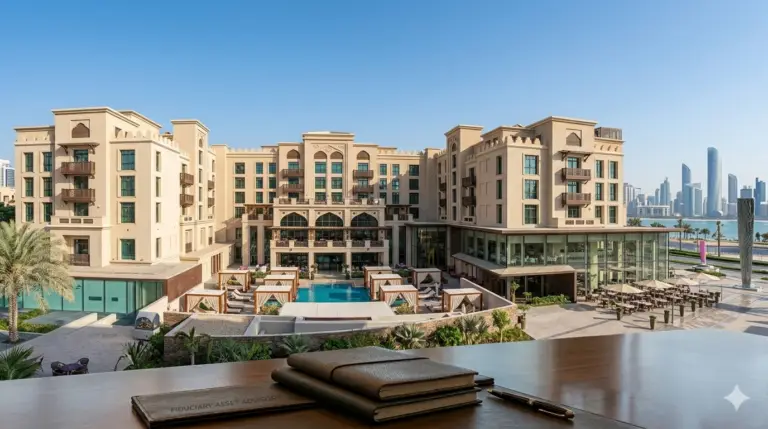
The May 30, 2026, deadline is not just a date—it is the starting gun for a high-stakes financial transformation
Beyond mere compliance, Boards must now navigate the intensive Capital Risk associated with binding Regulatory Asset Transformation. Decisions made in the next 12 months will dictate asset viability, star classification, and terminal value until 2030 and far beyond.
Executive Summar
-
The Strategic Shift:
May 30, 2026, marks the end of voluntary ESG. The focus now shifts to the board-level approval of mandatory Emission Reduction Roadmaps. -
The Compliance Chain:
4- and 5-star hotels must bridge the gap between the 2027 DET mandate, the 2030 sectoral pathway (-56%), and the 2035 statutory mandate (-79%). -
Defining Capital Risk:
Unaudited roadmaps lead to technology lock-ins and misallocated CapEx, threatening long-term asset value and exit yields.
The 2027 Compliance Alert: A Mandate for 4 & 5-Star Assets
Unlike general national goals, the Dubai DET Sustainability Requirements 2025 introduce a mandatory clock for the luxury segment. By 2027, all 4- and 5-star hotels must submit verified reduction targets aligned with the UAE Net Zero 2050 Strategy.
This is the critical link: To be compliant, your roadmap must demonstrate credible, data-backed milestones for:
-
2030: The -56% reduction pathway (as per the UAE Sustainable Built Environment Blueprint).
-
2035: The -79% mandatory target (as per the UAE’s National NDC 3.0).
Failure to provide a defensible trajectory doesn’t just impact your ESG rating—it jeopardizes your official hotel classification and long-term operating license.
2026/2027 – The Window of Binding Capital Commitment
While the May 30, 2026, deadline sets the regulatory stage, the real financial weight lies in the immediate aftermath. Throughout 2026 and 2027, Boards must finalize and approve binding roadmaps for Regulatory Asset Transformation.
This is the “Point of No Return.” The pathways approved now will lock in capital and define the operational cost base for the entire implementation cycle through 2029. Any misalignment today creates a compounding financial deficit by 2030.
The Hidden Capital Risk in Decarbonization
Many Emission Reduction Roadmaps appear sound on paper but fail when subjected to technical or financial stress tests. Without an independent fiduciary audit, hotel owners face significant Capital Risk:
-
Stranded Asset Risk: Investing in technology that satisfies immediate needs but becomes obsolete before the 2030 or 2035 milestones.
-
Contractual Lock-in: Misalignment between technical retrofits and existing District Cooling (PPA) governance, preventing cost recovery and inflating OpEx.
-
Implementation Gaps: Roadmaps that lack a realistic timeline, leaving the asset non-compliant by 2029 due to procurement bottlenecks or labor shortages.
My Role – Your Independent Fiduciary Shield
This is where my expertise bridges the gap between engineering and the boardroom. Drawing on over a decade as a Senior Manager in the German Utility and ESCO sector, I specialize in dissecting complex energy and emission pathways for high-value assets.
I serve as an independent authority to provide Boards with:
-
Roadmap Audits: Validating that the proposed -56% (2030) and -79% (2035) paths are technically feasible and life-cycle aligned.
-
Verified Compliance Firewall
Clear visibility of legal exposure, compliance gaps and liability risks ahead of the May 30, 2026 deadline. - CapEx Safeguard
An independent decision filter protecting owners from premature investments, vendor-driven bias and irreversible technology lock-ins. - Strategic Decision Sovereignty
Complete owner-side control over Net-Zero decisions—independent from vendor agendas, operator interests and technology-driven pressure.