
Executive Summary:
- The Reality Check: May 30, 2026, requires an active, audited mrv.ae emissions infrastructure, not just a data plan.
- The Execution Gap: March 31, 2027, locks in mandatory, independent third-party audits of all EAD (Environment Agency – Abu Dhabi) submissions.
- The CapEx Threat: Achieving the 2027 (-22%) and 2030 (-56%) targets requires deep engineering overhauls, not behavioral tweaks.
- The Hidden Risk: Hasty buying vendor solutions now will lock your asset into premature, multi-million dollar capital traps.
1. The 2026 Execution Gap: From Logging Data to Surviving Audits
The time for soft reporting is officially over. The federal climate law (Federal Decree-Law No. 11/2024) means that by May 30, 2026, your property must have an active, fully commissioned Monitoring, Reporting, and Verification (MRV) data infrastructure linked to the national portal.
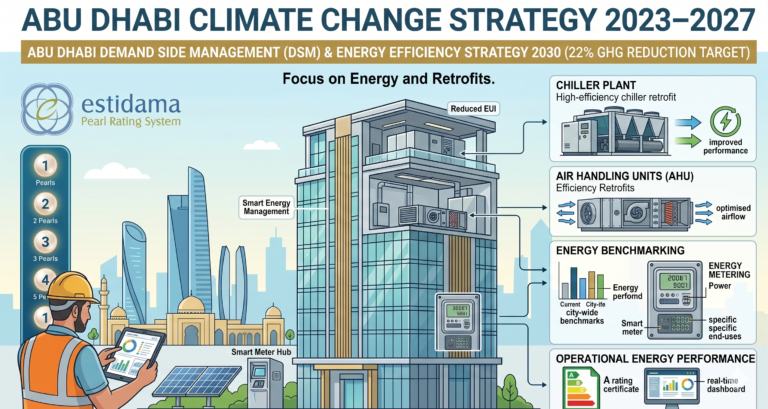
But here is what most operators miss: the law requires the immediate submission of a structured Emissions Reduction Plan for Scope 1 and 2. A legally defensible reduction baseline cannot exist in a vacuum—it must be structurally backed by concrete engineering concepts. To satisfy federal auditors, your baseline must explicitly demonstrate the exact technical levers—such as chiller plant optimization, waste Air Handling Units retrofits, or automated building controls—that physically enable and guarantee these projected carbon reductions. Relying on superficial utility data without a defined engineering concept leaves your asset entirely exposed
Come March 31, 2027, every single data point submitted to the Environment Agency – Abu Dhabi (EAD) must undergo a mandatory Third-Party Verification by a MOCCAE-accredited independent auditor. If those baselines are flawed, or if your mitigation roadmap cannot be mathematically verified, the statutory fines (up to 2,000,000 AED) hit the owner, not the operator.
2. The 2027 Chiller Crunch: Why Near-Term Engineering Dictates 2030 Survival
You cannot behaviorally manage your way to Abu Dhabi’s mandatory -22% emirate-wide carbon reduction by 2027 or the looming -56% built environment threshold by 2030. Central cooling and Air Handling Units (AHUs) account for up to 70% of a UAE hotel’s energy profile. To survive the impending Department of Energy (DoE) Chiller Audits, boards must brace for high-CapEx, deep engineering interventions.
To bridge the gap between today’s operational status and the 2027/2030 mandates, asset owners must evaluate heavy capital overhauls:
- Technical Chiller Plant Optimizations: Executing variable speed drive (VSD) retrofits, compressor overhauls, or full replacements with high-efficiency magnetic-bearing chillers to structurally optimize the Coefficient of Performance (COP).
- Demand-Controlled Ventilation (DCV): Overhauling energy-heavy ventilation systems and fresh-air intake cycles with heat recovery wheels to handle extreme ambient desert temperatures without spiking carbon intensity.
- Deep BMS Integration & Building Envelope Sealing: Transitioning from simple guestroom key-card switches to advanced Building Management System (BMS) automation paired with high-performance glazing retrofits to permanently stop thermal transfer and cooling energy loss.
3. The Danger of the Premature Capital Trap
Because the 2026 and 2027 deadlines are active, hotel assets are currently flooded with aggressive technology pushes from green-tech vendors and consultants eager to sell expensive hardware.
If you authorize a million-dollar chiller retrofit or a massive smart-thermostat deployment before conducting a fiduciary baseline audit, you are highly likely to fall into a “lock-in” risk. You risk over-specifying equipment, exacerbating HMA split-incentive bottlenecks, or committing to restrictive PPAs that limit your future strategic optionality.
4. The Solution: Secure Your Asset Before May 30 with a Phase 0 Rapid Governance & CapEx Risk Audit
Before you commit a single Dirham of CapEx or upload unverified data to the federal portal, you need an absolute firewall.
Our Phase 0: Rapid Governance & CapEx Risk Audit is an immediate, independent strategic intervention designed to insulate your board and shield your asset from premature investments before the statutory 2026 clock runs out.
- Executive Risk Mapping: Unfiltered status quo analysis of your immediate 2026 compliance deficits, contractual bottlenecks (HMA split-incentives, District Cooling traps), and imminent stranded asset risks ahead of the May 30 threshold.
- Strategic Scope: Immediate gap-check of your federal and local regulatory readiness, alongside a rigorous data-integrity audit to verify the baseline numbers that must feed into your mandatory 2026 emissions profile.
- Board Deliverables: A documented, audit-ready Fiduciary Board Dossier acting as your compliance firewall, paired with a Strategic Decision Matrix that separates immediate 2026 legal mandates from future long-term optionality.
The Outcome: Phase 0 delivers a complete, legally defensible decision baseline—not just another engineering report. It provides the transparency required for Boards to instantly secure the May 30 compliance firewall while successfully shielding the asset from premature, multi-million dollar investment traps.
???? [Secure Your May 30 Compliance Firewall: Explore Our Phase 0 Services Now] (Link to Service Page)