
Management Summary
- Net Zero Asset Transformation is primarily an ownership and investment challenge rather than a purely technical or ESG challenge.
- Most organisations already have Asset Managers, ESG Managers and Technical Managers, but often lack someone coordinating the transformation from an ownership perspective.
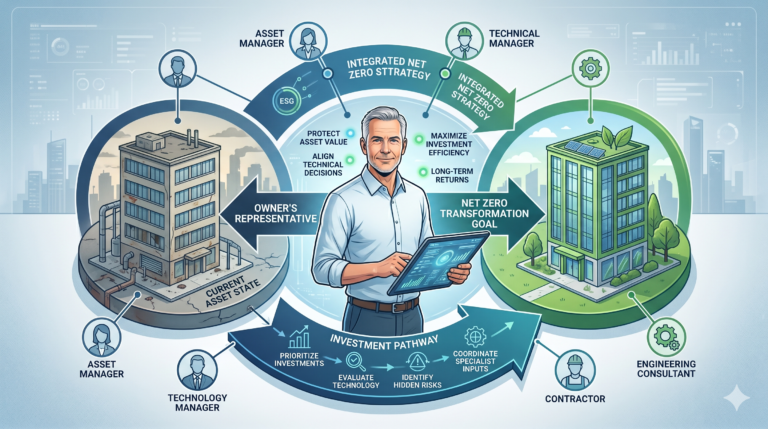
- The Owner’s Representative bridges the gap between Asset Management, ESG, Engineering and Operations.
- The objective is not simply to reduce emissions but to maximise investment efficiency while protecting asset value and long-term returns.
- The role extends across the full lifecycle from investment planning and procurement through implementation oversight and performance verification.
Why Property Owners Need More Than ESG Managers, Energy Auditors and Technical Consultants
Many property owners assume that Net Zero transformation can be delegated to ESG managers, energy auditors, engineering consultants or contractors.
In reality, major decarbonisation and infrastructure renewal decisions often fall into the gaps between these disciplines.
- An ESG Manager may focus on emissions and reporting.
- A Technical Asset Manager may focus on infrastructure condition and maintenance.
- An Asset Manager may focus on asset performance and valuation.
- Engineering consultants focus on technical solutions.
- Contractors focus on implementation.
- Technology vendors focus on their products.
Yet none of these stakeholders is typically responsible for answering the most important question from an ownership perspective:
Which investment pathway is most likely to improve asset value, support Net Zero objectives and deliver superior long-term investment performance?
This is where the role of an Owner’s Representative for Net Zero Asset Transformation becomes increasingly important.
Why Net Zero Has Become an Ownership Issue
Across the UAE and globally, building owners face increasing pressure to reduce emissions, modernise ageing infrastructure and align with Net Zero objectives.
At the same time, many buildings are approaching major investment cycles.
- Chillers reach end-of-life.
- Cooling systems require renewal.
- District cooling opportunities emerge.
- Electrification becomes a strategic consideration.
- Renewable energy technologies continue to evolve.
These decisions influence far more than emissions.
They affect:
- Capital expenditure
- Operating costs
- Asset value
- Technology risk
- Regulatory compliance
- Future flexibility
- Long-term investment returns
As a result, Net Zero transformation is no longer simply a sustainability initiative.
It has become a strategic ownership challenge.
The Problem: Everyone Sees Only Part of the Picture
Most professional real estate organisations already have highly qualified specialists.
Typical stakeholders include:
- Asset Managers
- Technical Asset Managers
- ESG Managers
- Facility Managers
- Engineering Consultants
- Energy Auditors
- Energy Performance Contractors
- Technology Vendors
Each brings valuable expertise.
The challenge is that each typically views the asset through a different lens.
- The ESG Manager focuses on emissions and reporting.
- The Technical Asset Manager focuses on infrastructure performance.
- The Asset Manager focuses on business plans, valuation and returns.
- Consultants focus on technical solutions.
- Contractors focus on project execution.
- Vendors focus on equipment.
Ownership, however, must make decisions that integrate all of these perspectives simultaneously.
Someone must evaluate how technical choices, contractual structures, investment timing, operating costs and future regulations interact over the next 10, 20 or 30 years.
This responsibility often falls into a gap that nobody formally owns.
What Is an Owner’s Representative for Net Zero Asset Transformation?
An Owner’s Representative for Net Zero Asset Transformation acts as an independent owner-side coordinator throughout the decarbonisation and infrastructure transformation journey.
The role is not to replace existing functions.
The role is to integrate them.
The objective is to help ownership make better decisions by ensuring that technical, commercial, contractual and investment considerations are evaluated together rather than in isolation.
An Owner’s Representative helps ownership:
- Understand alternative investment pathways
- Evaluate technology options
- Identify hidden risks
- Prioritise investments
- Coordinate specialist inputs
- Improve investment efficiency
- Protect asset value
- Improve long-term investment performance
Most importantly, the role ensures that Net Zero transformation remains aligned with ownership objectives rather than becoming driven by individual technologies, consultants or contractors.
Why Traditional Approaches Often Fail
One of the most common mistakes I have observed throughout more than 30 years in energy infrastructure, Energy Performance Contracting and major retrofit programmes is that technically sound projects are often implemented without sufficient evaluation of alternative pathways.
A typical example involved a property owner who had received an Energy Performance Contracting proposal.
The proposal promised substantial energy savings and appeared highly attractive.
However, the agreement contained more than thirty pages of contractual provisions that significantly affected the allocation of risks, responsibilities and future flexibility.
The owner lacked the specialist experience required to evaluate:
- The contractual implications
- The allocation of risks
- Energy baselines, which are the base for the contractor’s compensation
- Complicated yearly calculation methodology of the contractor’s performance-based compensation
- The Appropriateness of the Proposed Compensation
Most importantly, no independent assessment had been undertaken to determine whether implementing the measures independently would generate better financial outcomes than accepting the proposed EPC structure.
The question was not whether the proposed measures were technically sound.
The question was whether the proposed pathway represented the best pathway for ownership.
These are fundamentally different questions.
Why Technical Expertise Still Matters
Many people assume that the role of an Owner’s Representative is primarily organisational.
In reality, effective owner representation requires deep technical expertise in major infrastructure renewal, energy efficiency retrofit programmes, Demand-Side Management (DSM) initiatives and complex building energy systems.
Owners do not simply need answers to questions such as:
- When should we invest?
- Which pathway should we follow?
- How should capital be prioritised?
- They also need answers to questions such as:
- Which chiller technology is most appropriate?
- Should cooling be supplied through district cooling or on-site generation?
- Is electrification the right solution?
- Are alternative technologies such as combined cooling, heat and power worth considering?
- Which ventilation strategy delivers the greatest benefit?
- Which technology provides the highest reduction in emissions per dollar invested?
Without the ability to evaluate these questions independently, ownership remains dependent on vendor proposals and consultant recommendations that may not necessarily align with long-term asset value objectives.
The Biggest Mistake in Building Decarbonisation
One lesson from hundreds of energy audits, major retrofit programmes and the assessment of more than 30,000 buildings under Abu Dhabi’s Demand Side Management Programme has remained remarkably consistent:
80% of the results often come from 20% of the systems.
The challenge is that many sustainability programmes focus on the wrong 80%.
Typical recommendations often include:
- LED lighting upgrades
- Smart room controls
- Electric vehicle charging stations
- Rooftop solar systems
- Domestic hot water heat pumps
- Artificial intelligence applications
While these measures may provide value, they frequently represent only a relatively small portion of total energy consumption.
In premium hospitality, commercial and mixed-use assets, the largest opportunities are often found within:
- Chiller plants
- Cooling systems
- Fresh air handling units
- Ventilation systems
- Major HVAC infrastructure
These systems often determine the majority of energy consumption, emissions and operating costs.
Yet many energy audits and sustainability studies focus disproportionately on smaller and more visible measures.
The result is that significant capital may be deployed without addressing the infrastructure systems that have the greatest impact on long-term performance.
Investment Efficiency: The KPI That Matters
Most sustainability programmes focus on emissions reduction.
Owners should focus on investment efficiency.
Investment efficiency measures how much emissions reduction is achieved for each unit of capital invested.
For example:
- Investment: USD 1 million
- Emissions reduction: 10,000 tonnes CO₂
- Investment Efficiency KPI: 100 USD invested per tonne of CO₂ reduced
The lower this figure becomes, the more efficiently capital is being deployed.
This often reveals that certain investments deliver significantly greater value than others.
The objective is not merely to reduce emissions.
The objective is to maximise the value created by every investment decision.
What Does an Owner’s Representative Actually Do?
The engagement typically begins with an independent review of existing documentation.
This may include:
- Energy Audit Reports
- Emission Reduction Plans
- Net Zero Roadmaps
- ESG Reports
- Vendor Proposals
- Engineering Studies
- Energy Performance Contracts
- Planned Capital Projects
This is followed by discussions with key stakeholders, including:
- Asset Management Teams
- ESG Managers
- Facility Managers
- Chief Engineers
- Technical Advisors
The objective is to establish an independent understanding of:
- Infrastructure condition
- Regulatory compliance
- Existing decarbonisation strategies
- Investment priorities
- Technical risks
- Commercial risks
An on-site assessment typically follows.
This assessment focuses on:
- Asset age
- Infrastructure condition
- Replacement requirements
- Efficiency opportunities
- Technical risks
- Alternative technology options
- Potential investment pathways
The result is a structured view of:
- Immediate actions
- Medium-term priorities
- Long-term transformation opportunities
Supporting the Full Transformation Lifecycle
Effective owner representation extends beyond planning.
It should support ownership throughout the entire transformation journey.
Phase 0 – Strategic Investment Planning
Establishing the baseline and evaluating alternative pathways.
Activities may include:
- Reviewing existing documentation
- Identifying gaps and risks
- Evaluating alternative technologies
- Assessing investment timing
- Prioritising opportunities
- Developing CapEx sequencing strategies
Phase 1 – Procurement & Investment Preparation
Supporting ownership before major commitments are made.
Activities may include:
- Reviewing consultant scopes
- Reviewing EPC proposals
- Evaluating vendor submissions
- Supporting procurement preparation
- Defining owner requirements
Phase 2 – Owner’s Representation & Investment Protection
Protecting ownership interests throughout implementation.
Activities may include:
- Reviewing major deviations
- Assessing change requests
- Evaluating technology substitutions
- Monitoring alignment with project objectives
- Reducing implementation risks
Phase 3 – Performance Verification & MRV
Ensuring that expected outcomes are achieved.
Activities may include:
- Reviewing operational performance
- Assessing emissions outcomes
- Verifying energy performance
- Supporting Measurement, Reporting and Verification (MRV)
- Identifying improvement opportunities
Why Experience Matters
Net Zero Asset Transformation spans multiple disciplines.
- Technical engineering alone is not sufficient.
- Neither is ESG expertise.
- Neither is project management.
Effective owner representation requires experience across the entire lifecycle of major infrastructure projects.
My own perspective has been shaped through more than three decades of leadership and project responsibility in energy infrastructure, major efficiency retrofit development, Energy Performance Contracting, and operational performance management.
As Senior Manager and Authorized Signatory within some of Germany’s leading utilities and energy services organisations, I was responsible for the development, financing, design, implementation and long-term operation of major Energy Performance Contracting and infrastructure modernisation programmes.
These projects included premium assets such as:
- Hamburg Airport
- Deutsche Oper Berlin
- Conrad Hotel
- Major shopping centres
- Government buildings
- Commercial assets
The responsibility extended far beyond technical design.
It included:
- Business case development
- Investment assessments
- Technical concept development
- Contractual structures
- Procurement
- Project implementation & supervision
- Long-term operational performance
- Measurement, Reporting & Verification (MRV)
As Lead Consultant for Abu Dhabi’s emirate-wide Demand Side Management Programme, I was involved in the assessment of more than 30,000 buildings and the identification of large-scale energy efficiency and emissions reduction opportunities across the Emirate.
This combination of utility, EPC, infrastructure, technical, financial, contractual and operational experience provides a perspective that differs significantly from traditional sustainability consulting.
Conclusion
Net Zero Asset Transformation is not simply about installing new technologies.
It is about making a series of investment decisions that will influence asset value, operating performance and investment returns for decades.
- Most organisations already possess technical expertise.
- Most organisations already possess ESG expertise.
What is often missing is independent owner-side coordination across all these disciplines.
An Owner’s Representative for Net Zero Asset Transformation fills that gap.
The objective is simple:
To help ownership identify the technologies, investment pathways and decisions most likely to improve asset value, reduce long-term risk and deliver superior investment performance while supporting Net Zero objectives.
To learn how independent owner-side advisory can support your Net Zero transformation strategy, explore our Net Zero Asset Transformation services.